
Selling scientific equipment is fundamentally different from selling ordinary consumer products.
A laboratory manager searching for an analytical instrument, a procurement department evaluating laboratory equipment suppliers, a pharmaceutical manufacturer comparing testing systems, or a university purchasing research equipment may spend weeks or months researching specifications, comparing manufacturers, requesting quotations and obtaining internal approvals before making a purchase.
That creates a major challenge for scientific equipment manufacturers, distributors, dealers, suppliers and resellers:
How do you consistently reach the right buyers before they contact your competitors?
This is where a specialist digital marketing company for scientific equipment lead generation can make a significant difference.
CRESOLTEK helps scientific equipment businesses build a stronger digital presence, attract high-intent prospects, generate qualified sales leads and turn technical expertise into measurable business opportunities through strategy-led B2B digital marketing.
Ready to Generate More Qualified Scientific Equipment Leads?
Turn your technical expertise into digital visibility, qualified leads, RFQs, and measurable business growth with CRESOLTEK’s strategy-led B2B digital marketing.
Get Your Free Scientific Equipment Marketing & Lead Generation Audit
📱 WhatsApp: +971 50 261 9810
📱 Mobile: +92 320 168 0360
📧 Email: info@cresoltek.com
Why Scientific Equipment Companies Need a Different Lead Generation Strategy
A scientific instrument is rarely an impulse purchase.
Buyers may need to evaluate:
- Technical specifications
- Accuracy and precision
- Applications
- Compliance requirements
- Certifications
- Compatibility
- Installation requirements
- Service and maintenance
- Warranty
- Training
- Spare parts
- Supplier reputation
- Total cost of ownership
- Return on investment
There may also be several people involved in the decision.
A laboratory scientist may define the technical requirements.
A laboratory manager may evaluate operational suitability.
Procurement may compare suppliers and commercial terms.
Finance may approve the budget.
Senior management may make the final investment decision.
This is why B2B scientific-equipment marketing needs to educate and influence multiple stakeholders rather than simply advertise a product.
LinkedIn describes B2B purchases as typically high-value, long-term and complex, often involving multiple decision-makers and longer buying journeys.
Your marketing therefore needs to work throughout the buyer journey—from initial research to product comparison, quotation request and sales conversation.
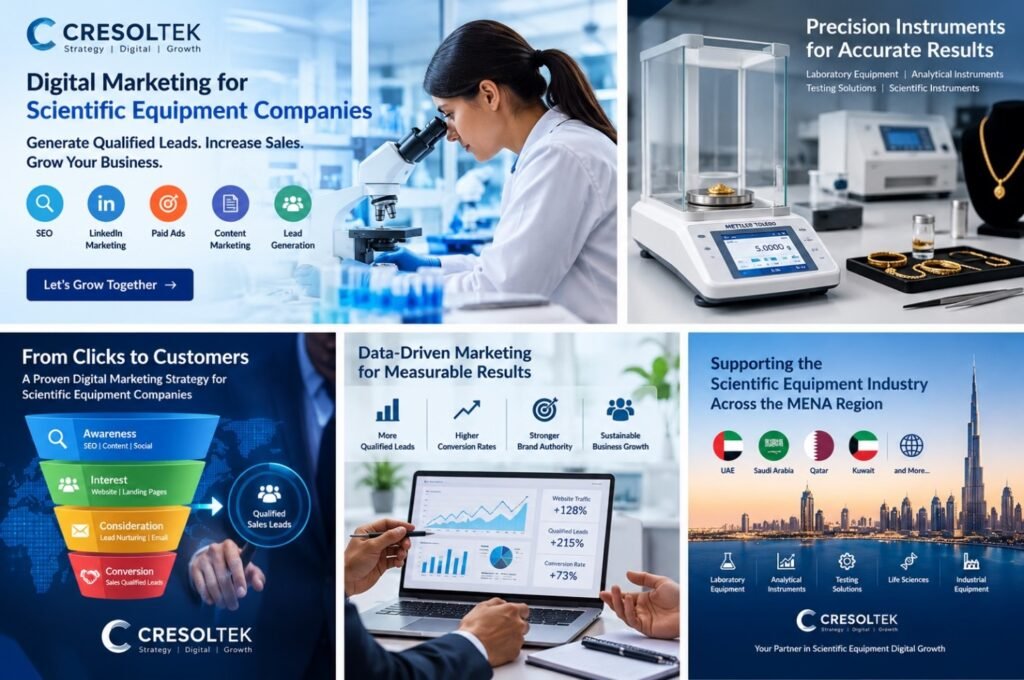
What Does a Scientific Equipment Lead Generation Company Do?
A specialist scientific equipment digital marketing agency creates a system designed to attract potential buyers and convert their interest into measurable enquiries.
The process can include:
Market Research → Buyer Identification → SEO → Content → Paid Search → LinkedIn → Landing Pages → Lead Capture → Lead Nurturing → Sales Handoff → Measurement
The objective isn’t simply to generate website visitors.
The objective is to generate qualified commercial opportunities.
For example:
Instead of targeting:
“What is laboratory equipment?”
You might target:
“automatic flash point tester supplier USA”
Or:
“XRF sulfur analyzer for petroleum laboratory”
Or:
“analytical balance for pharmaceutical laboratory”
Or:
“laboratory equipment supplier for oil testing”
These searches demonstrate much stronger commercial intent.
High-Intent Keywords Are the Foundation of Scientific Equipment Lead Generation
One of the biggest mistakes scientific equipment companies make is trying to rank for broad keywords.
For example:
“laboratory equipment”
may generate substantial search volume, but it is extremely broad.
A buyer searching:
“automatic sulfur analyzer supplier Texas”
has a much clearer commercial requirement.
Likewise:
“XRF spectrometer price USA”
or
“flash point tester distributor USA”
can indicate that the searcher is much further along the buying journey.
This is why CRESOLTEK recommends building a high-intent keyword strategy around products, applications, specifications, industries, brands and purchasing actions.
Examples of High-Intent Long-Tail Keywords
Depending on your product portfolio, your website could target searches such as:
Product-Based Keyword
- laboratory equipment supplier USA
- scientific equipment supplier USA
- analytical instrument supplier USA
- laboratory testing equipment supplier
- scientific instruments distributor
- laboratory equipment distributor Texas
- scientific instrument distributor California
Product + Application Keywords
- laboratory equipment for pharmaceutical testing
- analytical instruments for petroleum laboratories
- scientific equipment for quality control laboratories
- laboratory instruments for food testing
- laboratory testing equipment for chemical analysis
Product + Commercial Intent
- laboratory equipment supplier near me
- laboratory equipment price USA
- scientific instrument quotation
- analytical instrument supplier USA
- laboratory testing equipment dealer
- scientific equipment distributor USA
Product-Specific Keywords
- automatic flash point tester supplier
- XRF sulfur analyzer supplier
- analytical balance supplier USA
- laboratory centrifuge distributor
- UV Vis spectrophotometer supplier
- laboratory moisture analyzer supplier
- density meter supplier
- petroleum testing equipment supplier
These long-tail searches may have lower search volume than broad keywords—but they can be significantly more valuable because they are closer to a purchasing decision.
1. Build a Scientific Equipment SEO Strategy
Search engine optimization for laboratory equipment companies should be at the centre of your long-term lead generation strategy.
Your website needs to be discoverable when buyers search for the exact products and solutions you sell.
A comprehensive SEO strategy should include:
Product SEO
Create dedicated, optimized pages for every important product and instrument category.
Application SEO
Explain how each instrument is used in real laboratory, industrial or scientific applications.
Industry SEO
Create content for specific sectors such as:
- Pharmaceutical
- Biotechnology
- Food & beverage
- Petroleum
- Petrochemical
- Chemical
- Environmental
- Healthcare
- Academic research
- Industrial manufacturing
Problem-Based SEO
Answer the problems your customers are trying to solve.
For example:
How to measure sulfur in petroleum products?
Which instrument is best for flash point testing?
How to determine moisture content in laboratory samples?
This combination allows your website to capture buyers at different stages of the research process.
Google’s guidance emphasizes creating helpful, reliable, people-first content rather than content produced primarily to manipulate search rankings.
For scientific-equipment companies, that means your content should demonstrate genuine technical knowledge—not simply repeat manufacturer specifications.
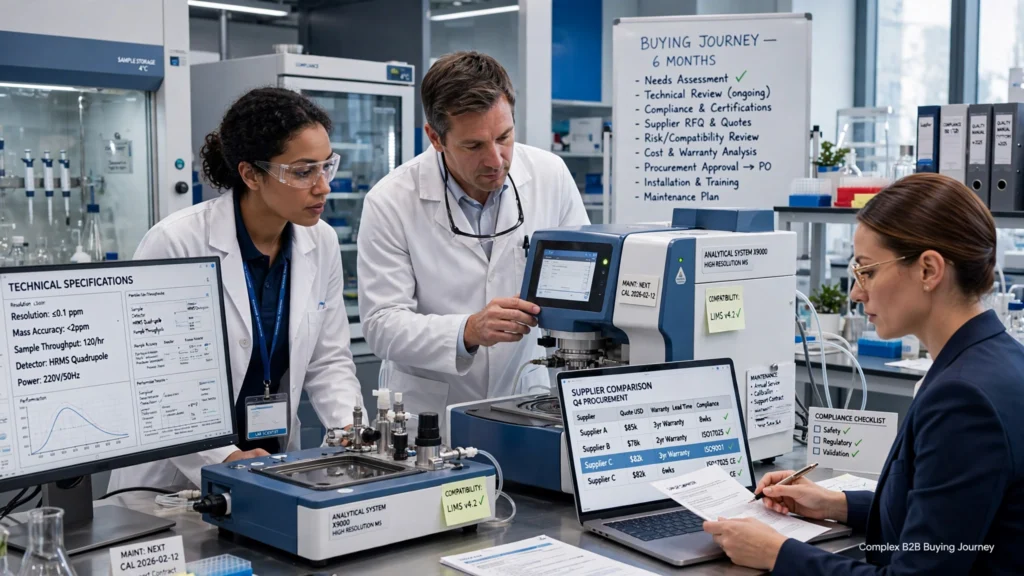
2. Turn Product Pages Into Lead-Generation Pages
A scientific equipment website should not function as an online catalogue alone.
Every important product page should answer:
What is this instrument?
What does it measure?
Who uses it?
What applications does it support?
What standards does it meet?
What are its specifications?
What problems does it solve?
Why should the buyer consider this model?
And most importantly:
What should the buyer do next?
Use clear calls-to-action such as:
Request a Quote
Get Pricing
Request Technical Consultation
Ask an Application Specialist
Download Technical Brochure
Schedule a Product Demonstration
This transforms a product page from an information page into a potential sales asset.
3. Use Technical Content to Build Authority
Scientific buyers don’t just want marketing claims.
They want information they can trust.
That is why technical content marketing for scientific instrument companies is so powerful.
Examples include:
- Application notes
- Technical guides
- Product comparisons
- Industry guides
- Testing-method explanations
- Standards-related articles
- Troubleshooting guides
- Product-selection guides
- Case studies
- White papers
- Technical videos
For example, instead of publishing:
“Our sulfur analyzer is highly accurate.”
Create:
How to Select an XRF Sulfur Analyzer for Petroleum Laboratory Testing
Then explain measurement principles, relevant standards, sample types, detection limits, workflow considerations and selection criteria.
At the end, introduce your product as one possible solution.
That approach builds credibility while capturing search demand.
4. Generate Leads Through Google Search Ads
SEO is a long-term investment.
Google Ads can provide immediate visibility for high-intent searches.
A carefully structured Google Ads campaign for laboratory equipment companies could target keywords such as:
“laboratory equipment supplier”
“scientific instrument supplier”
“XRF analyzer supplier”
“flash point tester price”
“petroleum testing equipment”
“laboratory equipment distributor”
But broad targeting can waste advertising budget.
Scientific-equipment campaigns should use:
- Exact and phrase-match intent
- Negative keywords
- Product-specific campaigns
- Application-specific campaigns
- Geographic targeting
- Landing pages
- Conversion tracking
- Lead-quality measurement
The goal should not be:
Maximum clicks.
It should be:
Maximum qualified enquiries from the right buyers.
5. Use LinkedIn for B2B Scientific Equipment Marketing
LinkedIn is particularly relevant to scientific equipment businesses because your target audience is professional and organizational.
Potential audiences include:
- Laboratory Managers
- Lab Directors
- QA Managers
- QC Managers
- R&D Managers
- Procurement Managers
- Scientific Directors
- Plant Managers
- Technical Directors
- Engineering Managers
- Research Scientists
- Purchasing Managers
LinkedIn identifies multiple departments and stakeholders as influential in B2B purchase decisions, reinforcing the need to communicate with more than one person inside a buying organization.
CRESOLTEK can help build LinkedIn campaigns around:
Industry + Job Function + Seniority + Geography + Company Type
This can be particularly valuable when selling expensive scientific instruments with longer buying cycles.
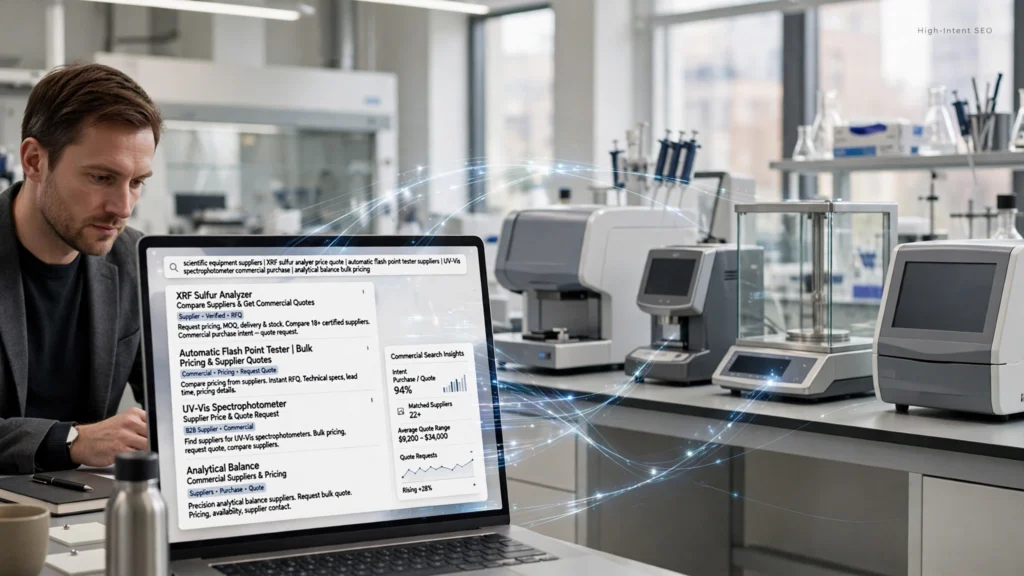
6. Account-Based Marketing for Scientific Equipment
You may need 50 highly relevant companies.
For high-value laboratory equipment, you may not need thousands of leads.
This is where Account-Based Marketing—or ABM—can become powerful.
For example, suppose your ideal customers are:
- Pharmaceutical manufacturers
- Oil laboratories
- Petrochemical companies
- Universities
- Contract research organizations
- Food-testing laboratories
Instead of advertising to everyone, identify target accounts and develop campaigns specifically for them.
The process can look like:
Target Account → Identify Decision Makers → Create Relevant Content → Reach Them Through Search/LinkedIn/Email → Capture Interest → Sales Engagement
This is especially useful for expensive instruments and complex laboratory systems.
7. Create Industry-Specific Landing Pages
A generic “Contact Us” page is rarely enough.
Create dedicated landing pages such as:
Laboratory Equipment for Pharmaceutical Companies
Scientific Instruments for Petroleum Laboratories
Analytical Equipment for Food Testing Laboratories
Laboratory Equipment for Universities & Research Institutions
Industrial Testing Equipment for Manufacturing Companies
Each page should explain:
- Industry challenges
- Relevant applications
- Equipment categories
- Technical considerations
- Benefits
- Relevant products
- Case studies
- FAQs
- CTA
This makes your marketing more relevant and can improve conversion rates.
8. Build a Lead Magnet Strategy
Not every buyer is ready to request a quotation today.
Some are researching.
Some are preparing budgets.
Some are comparing technologies.
Some are developing specifications.
Capture these prospects with useful resources.
Examples:
Laboratory Equipment Buying Guide
Scientific Instrument Selection Checklist
2026 Guide to Laboratory Equipment Procurement
Laboratory Equipment Specification Template
Analytical Instrument Buyer’s Guide
Scientific Equipment ROI Calculator
The buyer provides basic information to access the resource.
You now have an identifiable prospect who can enter an appropriate nurturing sequence.
9. Nurture Scientific Equipment Leads
Generating a lead is not the end of marketing.
It may be the beginning.
Scientific equipment buying cycles can be lengthy, and prospects may not be ready to purchase when they first contact you.
Your follow-up sequence could include:
Email 1: Thank you + requested information
Email 2: Technical application guide
Email 3: Product comparison
Email 4: Case study
Email 5: Technical webinar/demo
Email 6: Request a consultation
The objective is to remain useful and credible until the buyer is ready.
10. Connect Marketing With Sales
One of the biggest problems in B2B marketing is the disconnect between marketing and sales.
Marketing says:
“We generated 200 leads.”
Sales says:
“Only 12 were useful.”
The solution is to define lead quality.
For example:
Marketing Qualified Lead
A prospect who has demonstrated meaningful interest.
Sales Qualified Lead
A prospect with a legitimate application, budget, purchasing timeframe or project.
Opportunity
A qualified commercial project.
Customer
A closed sale.
This enables CRESOLTEK to measure marketing based on business outcomes rather than vanity metrics.
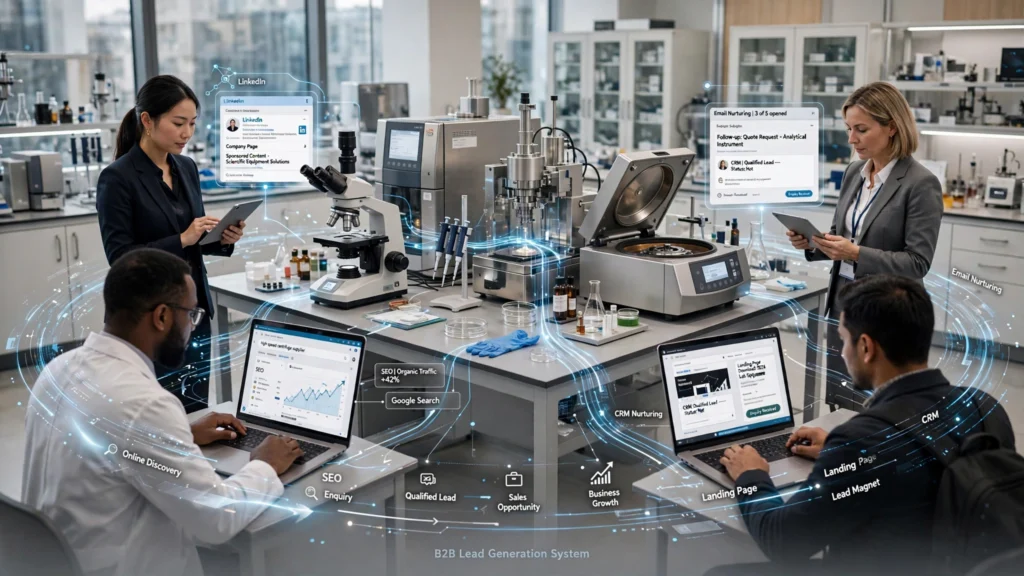
11. Measure What Actually Matters
Scientific equipment companies should track more than website traffic.
Important metrics include:
- Qualified leads
- RFQs
- Product enquiries
- Demo requests
- Quote requests
- Cost per qualified lead
- Lead-to-opportunity rate
- Opportunity-to-sale rate
- Sales pipeline value
- Customer acquisition cost
- Revenue generated
- Return on marketing investment
Imagine:
10,000 website visitors
sounds impressive.
But:
75 qualified enquiries → 20 opportunities → 7 customers
is much more valuable to a scientific equipment manufacturer.
12. Make Your Website AI- and Search-Friendly
The way B2B buyers discover information is changing.
Buyers increasingly use search engines, professional networks and AI tools to research technical solutions.
LinkedIn’s 2026 B2B research highlights the growing role of AI in buyer research and the importance of being discoverable during the research stage.
This means scientific equipment companies should build content that clearly explains:
- Products
- Applications
- Technical specifications
- Standards
- Industries
- Use cases
- Company expertise
- Service capabilities
- FAQs
The goal is to make your company easy for both human buyers and modern search/discovery systems to understand.
13. Why Generic Digital Marketing Agencies Often Struggle With Scientific Equipment
A generalist agency may understand:
SEO + Google Ads + social media.
But scientific equipment marketing requires something more.
You need to understand the buyer.
You need to understand technical terminology.
You need to understand long sales cycles.
You need to understand specifications.
You need to understand applications.
You need to understand distributors and manufacturers.
You need to understand the difference between:
traffic
and
qualified technical buyers.
This is where a specialist approach can create an advantage.
CRESOLTEK is positioned specifically around B2B digital marketing for laboratory equipment, scientific instruments and technical industries.
14. CRESOLTEK’s Strategy-Led Approach
At CRESOLTEK, we believe scientific equipment marketing should begin with strategy—not random campaigns.
Our approach can be structured around:
01. Market Intelligence
Identify markets, competitors, applications and opportunities.
02. Buyer Intelligence
Understand technical buyers, procurement teams and decision-makers.
03. Positioning
Clarify what makes your company and products different.
04. Digital Foundation
Build a high-performing website, analytics and conversion infrastructure.
05. Authority
Develop technical content, thought leadership and trust.
06. Demand Generation
Use SEO, Google Ads, LinkedIn and other channels to attract qualified prospects.
07. Sales Enablement
Provide content and tools that help sales teams convert opportunities.
08. Measurement
Connect marketing activities with leads, pipeline and revenue.
This creates a connected B2B growth system rather than isolated marketing activities.
15. Who Can Benefit From Scientific Equipment Lead Generation?
CRESOLTEK can support digital marketing and lead-generation strategies for:
Scientific Equipment Manufacturers
Build direct market demand and strengthen brand authority.
Laboratory Equipment Suppliers
Generate enquiries from laboratories and organizations searching for equipment.
Scientific Instrument Distributors
Increase visibility for the brands and product categories they represent.
Dealers
Generate local and regional enquiries.
Resellers
Build product-specific search visibility and conversion campaigns.
Laboratory Equipment Importers
Develop digital demand in target markets.
Industrial Instrument Companies
Reach manufacturing, testing and quality-control departments.
Analytical Instrument Companies
Target laboratories actively researching analytical solutions.
16. What Does a Successful Scientific Equipment Lead Generation System Look Like?
Imagine a potential customer searches Google for:
“XRF sulfur analyzer for petroleum laboratory”
They find your technical guide.
The guide explains:
- What XRF sulfur analysis is
- Relevant applications
- Important specifications
- Testing considerations
- Instrument selection factors
The buyer then visits your product page.
They download the brochure.
They request a quotation.
The CRM records the lead.
Marketing identifies the source.
Sales receives the enquiry.
The prospect is followed up.
Eventually:
Visitor → Lead → Qualified Lead → Opportunity → Customer
That’s what a proper digital lead-generation system should accomplish.
17. Stop Measuring Marketing by Traffic Alone
Traffic is important.
But traffic without commercial intent is not enough.
For scientific equipment businesses, the more useful question is:
Are the right laboratory, industrial, pharmaceutical, research and procurement professionals finding us when they need the equipment we sell?
If the answer is yes, your digital marketing is doing its job.
If the answer is no, increasing traffic alone will not solve the problem.
You need better:
Targeting + Content + Search Intent + Conversion + Lead Qualification + Measurement.
Conclusion: Turn Your Scientific Equipment Website Into a Sales Engine
The scientific equipment industry doesn’t need more generic advertising.
It needs specialized B2B marketing built around technical buyers and commercial intent.
A successful strategy combines:
SEO
High-intent keywords
Technical content
Google Ads
LinkedIn marketing
Account-based marketing
Conversion-focused websites
Landing pages
Lead magnets
Email nurturing
Sales enablement
CRM integration
Analytics
When these components work together, your website can become more than an online catalogue.
It can become a 24/7 B2B lead-generation engine.
And that is the opportunity for scientific equipment manufacturers, distributors, suppliers, dealers and resellers that are ready to move beyond traditional marketing.
Looking for a Digital Marketing Company for Scientific Equipment Lead Generation?
CRESOLTEK helps scientific equipment and laboratory instrument businesses build digital visibility, attract qualified buyers, generate sales enquiries and create measurable growth through strategy-led B2B digital marketing.
Whether you manufacture analytical instruments, distribute laboratory equipment, supply testing systems or represent scientific brands, we can help you build a digital strategy around your products, markets and buyers.
Ready to Generate More Qualified Scientific Equipment Leads?
Book a B2B Digital Marketing Strategy Call with CRESOLTEK.
Let’s turn your technical expertise into digital visibility, qualified leads and measurable business growth.
Get Your Free Scientific Equipment Marketing & Lead Generation Audit
25 FAQs – Digital Marketing for Scientific Equipment Lead Generation
1. What is digital marketing for scientific equipment companies?
Digital marketing for scientific equipment companies uses SEO, Google Ads, LinkedIn marketing, technical content, landing pages, email marketing, and other digital channels to attract and convert potential laboratory, industrial, research, and scientific equipment buyers.
2. How can digital marketing generate leads for scientific equipment companies?
Digital marketing can attract potential buyers who are actively searching for scientific instruments and laboratory equipment. SEO, paid search, LinkedIn campaigns, technical content, and optimized product pages can turn this traffic into quote requests, product enquiries, demo requests, and qualified sales leads.
3. What is scientific equipment lead generation?
Scientific equipment lead generation is the process of identifying and attracting potential customers interested in purchasing laboratory equipment, analytical instruments, testing equipment, scientific instruments, or related technical solutions and converting them into sales opportunities.
4. What is the best digital marketing strategy for scientific equipment companies?
A strong strategy combines high-intent SEO, technical content marketing, Google Search Ads, LinkedIn marketing, conversion-focused landing pages, lead nurturing, and CRM tracking. The exact combination should be based on the products, target industries, geographic markets, and sales cycle.
5. How can SEO help a scientific equipment company generate sales leads?
SEO helps your website appear when potential customers search for products, applications, suppliers, specifications, and solutions. Targeting high-intent phrases such as “laboratory equipment supplier USA” or “XRF analyzer supplier” can attract visitors who are closer to making a purchasing decision.
6. What are high-intent keywords for scientific equipment companies?
High-intent keywords are searches that indicate a potential purchasing or supplier requirement. Examples include “scientific equipment supplier,” “laboratory equipment distributor,” “analytical instrument supplier,” “laboratory equipment price,” “testing equipment supplier,” and product-specific searches containing terms such as supplier, distributor, dealer, price, quote, or buy.
7. Why are long-tail keywords important for laboratory equipment lead generation?
Long-tail keywords are more specific and often reveal the searcher’s exact requirement. For example, “automatic flash point tester supplier USA” is much more commercially specific than simply “laboratory equipment.” This can help attract more relevant prospects.
8. Can Google Ads generate qualified leads for scientific instrument companies?
Yes. Google Search Ads can reach prospects actively searching for specific scientific instruments or suppliers. Campaigns should be built around commercial-intent keywords, relevant landing pages, geographic targeting, negative keywords, and conversion tracking to improve lead quality.
9. Is LinkedIn marketing effective for scientific equipment companies?
Yes. LinkedIn can be useful for reaching professional decision-makers such as laboratory managers, procurement managers, QA/QC managers, R&D professionals, technical directors, and plant managers. It can be particularly valuable for high-value B2B scientific equipment with longer buying cycles.
10. How can a scientific equipment manufacturer get more B2B leads online?
Manufacturers can increase B2B leads by optimizing product pages, targeting high-intent keywords, publishing technical content, running Google Search campaigns, using LinkedIn, developing industry-specific landing pages, offering technical resources, and implementing effective lead capture and follow-up systems.
11. What type of content works best for scientific equipment marketing?
Effective content includes technical guides, application notes, product comparisons, buying guides, case studies, testing-method articles, industry solutions, FAQs, technical videos, and product-selection guides. Content should answer the questions buyers have before contacting a supplier.
12. How can product pages generate more laboratory equipment leads?
Product pages should provide clear specifications, applications, benefits, certifications where applicable, downloadable technical information, images, FAQs, and strong calls-to-action such as Request a Quote, Get Pricing, Request a Demo, or Talk to an Application Specialist.
13. Should scientific equipment companies create separate landing pages for different industries?
Yes. Industry-specific landing pages can make your marketing more relevant to particular audiences. For example, you could create pages for pharmaceutical laboratories, petroleum laboratories, food-testing laboratories, chemical manufacturers, universities, research institutions, and industrial quality-control departments.
14. What is the difference between website traffic and qualified scientific equipment leads?
Website traffic represents visitors to your website. A qualified lead is a prospect with a relevant application, genuine interest, and potential purchasing requirement. For scientific equipment companies, qualified enquiries and sales opportunities are generally more valuable than traffic volume alone.
15. How can a digital marketing agency improve laboratory equipment website conversions?
An agency can improve conversions by optimizing product pages, calls-to-action, enquiry forms, landing pages, navigation, technical content, trust signals, and conversion tracking. The objective is to make it easier for a potential buyer to move from research → enquiry → sales conversation.
16. How long does SEO take to generate leads for scientific equipment companies?
SEO is generally a long-term strategy. Results depend on competition, domain authority, website quality, keyword difficulty, content quality, geographic targeting, and the existing online presence of the company. High-intent product and application pages can become important lead-generation assets as organic visibility develops.
17. How much does digital marketing for scientific equipment companies cost?
The cost depends on factors such as the number of products, target markets, competition, advertising budget, SEO requirements, content volume, and lead-generation objectives. A customized strategy is generally more appropriate than a one-size-fits-all marketing package.
18. Can digital marketing help scientific equipment distributors and dealers?
Yes. Distributors and dealers can use digital marketing to increase visibility for the brands and products they represent, target local and regional buyers, generate enquiries, promote specific instruments, and compete for high-intent searches in their target markets.
19. What is the best CTA for a scientific equipment website?
Effective CTAs include Request a Quote, Get Pricing, Request Product Information, Schedule a Demo, Talk to an Application Specialist, Request Technical Consultation, and Download Technical Brochure. The best CTA depends on where the visitor is in the buying journey.
20. How can scientific equipment companies nurture leads that are not ready to buy?
Companies can use email marketing and marketing automation to provide technical guides, application notes, product comparisons, case studies, webinars, product updates, and other useful information. This keeps the company visible until the prospect is ready to engage with sales.
21. What is account-based marketing for scientific equipment companies?
Account-Based Marketing (ABM) focuses marketing efforts on specific high-value organizations rather than targeting a broad audience. For expensive laboratory and scientific instruments, ABM can help companies target selected pharmaceutical manufacturers, laboratories, universities, industrial companies, research organizations, or other strategic accounts.
22. How should scientific equipment companies measure digital marketing success?
Important metrics include qualified leads, RFQs, product enquiries, demo requests, cost per qualified lead, lead-to-opportunity rate, sales pipeline value, customer acquisition cost, and revenue generated. These metrics provide a clearer picture than website traffic alone.
23. Can content marketing help sell expensive scientific instruments?
Yes. High-value scientific instruments often require significant research before purchase. Technical content can educate buyers, demonstrate expertise, answer objections, explain applications, and build trust before the prospect contacts the sales team.
24. Why should a scientific equipment company work with a specialized digital marketing agency?
Scientific equipment marketing requires an understanding of technical products, laboratory applications, B2B buying journeys, scientific terminology, long sales cycles, and specialized search intent. A specialist agency can combine this understanding with SEO, paid advertising, content marketing, conversion optimization, and lead-generation strategy.
25. How can CRESOLTEK help my scientific equipment company generate more leads?
CRESOLTEK provides strategy-led B2B digital marketing for laboratory equipment, scientific instruments, and technical businesses. Services can include scientific equipment SEO, technical content marketing, Google Ads, LinkedIn marketing, landing pages, lead generation, sales enablement, market analysis, and digital performance measurement.
Need a B2B Digital Marketing Strategy for Your Scientific Equipment Business?
CRESOLTEK helps scientific equipment manufacturers, suppliers, distributors, dealers, and resellers attract qualified buyers and generate more sales enquiries.
Book a B2B Digital Marketing Strategy Call with CRESOLTEK.
📱 WhatsApp: +971 50 261 9810
📱 Mobile: +92 320 168 0360
📧 Email: info@cresoltek.com