
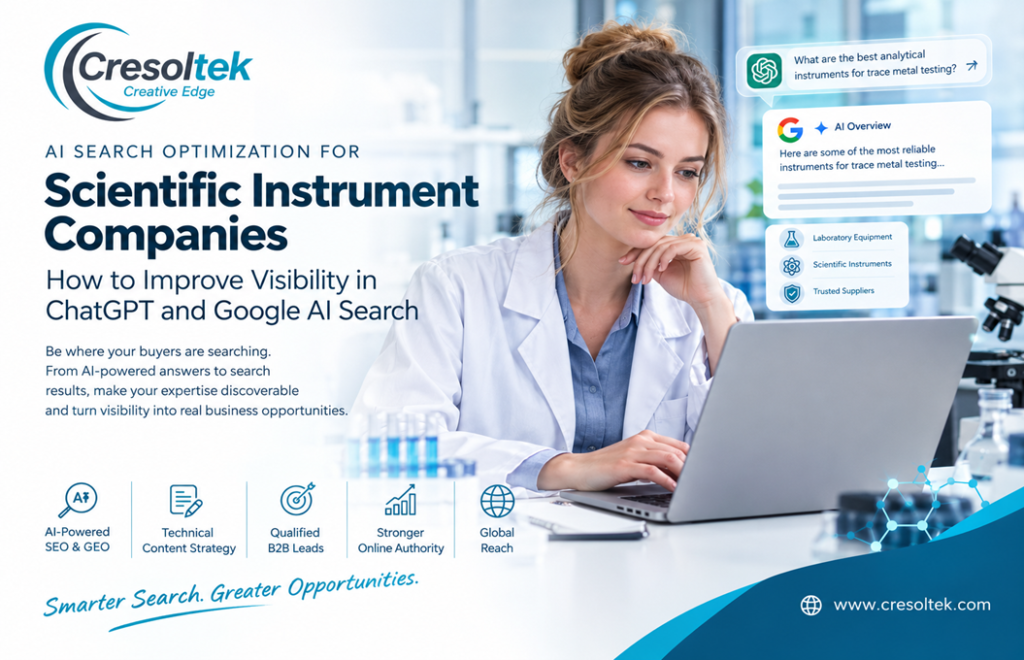
Introduction: AI Search Is Changing How Scientific Buyers Discover Suppliers
Scientific instrument companies operate in a highly specialized B2B market. Laboratory managers, researchers, procurement professionals, quality control teams, and industrial engineers rarely choose expensive instruments based on a single advertisement. They research specifications, compare manufacturers, investigate applications, review technical documentation, and assess supplier credibility before requesting a quotation.
Today, this research process increasingly includes AI-powered search experiences. Buyers may use ChatGPT to compare analytical instruments, Google AI Overviews to understand laboratory technologies, or other AI assistants to explore suppliers and product alternatives.
This creates an important opportunity for scientific instrument manufacturers, laboratory equipment suppliers, distributors, and resellers: make your business easier to discover, understand, evaluate, and reference across both traditional search engines and AI-powered search platforms.
AI search optimization helps businesses strengthen these signals through technical SEO, authoritative content, consistent company information, accessible product documentation, and a clear digital presence.
At CRESOLTEK, we focus on digital marketing for laboratory equipment, scientific instruments, and technical B2B businesses. Our approach connects AI-powered SEO and generative engine optimization with the commercial objective that matters most: reaching relevant buyers and generating qualified business opportunities.
1. What Is AI Search Optimization?
AI search optimization is the process of improving a website and its broader digital presence so that AI-powered search experiences can discover, interpret, and potentially reference its information when answering relevant questions.
It overlaps with several related disciplines:
- Search engine optimization (SEO): Improving visibility in traditional organic search results.
- Answer engine optimization (AEO): Making useful information accessible for systems that answer users’ questions.
- Generative engine optimization (GEO): Increasing the chances of a brand and its content being recognized and referenced by AI-powered search platforms.
- Content and entity optimization: Clearly communicating what a company does, which products it provides, which industries it serves, and what makes its expertise relevant.
These approaches share a common foundation: technically accessible websites, helpful and reliable content, clear product information, and genuine authority.
Google recommends continuing to apply proven SEO fundamentals when optimizing for AI Overviews and AI Mode, as no specific markup or strategy can guarantee that content will appear in AI-generated responses. Google Search Central’s AI optimization guide explains the importance of crawlability, useful content, and established search fundamentals.
For scientific instrument companies, AI search optimization should therefore be treated as an extension of a strong B2B digital marketing strategy, not a replacement for SEO.
2. Why AI Search Matters for Laboratory Equipment Companies
Scientific buyers often search with specific technical questions rather than broad commercial phrases. They may want to understand measurement accuracy, detection limits, sample compatibility, calibration procedures, testing standards, maintenance requirements, or differences between instrument models.
A supplier with detailed, accurate, and accessible information can provide a more useful resource for these research journeys than a website containing only short promotional descriptions.
Consider these example buyer questions:
- Which analytical instrument is suitable for trace-metal testing?
- What factors should laboratories consider when selecting a spectrophotometer?
- How do different moisture analyzers compare?
- What is the difference between a laboratory instrument and an industrial testing system?
- Which supplier offers technical support and calibration services for a particular instrument category?
These are examples of potential buyer queries, not verified search-volume rankings.
When your website answers relevant questions thoroughly and connects those answers to appropriate products, applications, and support resources, you give search systems and prospective customers clearer information to evaluate.
AI search visibility may also help introduce your company to buyers who have not yet searched for your brand by name. However, appearance in ChatGPT, Google AI Overviews, or another platform is not guaranteed, and visibility does not automatically translate into qualified leads.
The objective is to strengthen your company’s discoverability throughout the research and evaluation process.
3. Build a Strong SEO Foundation Before Pursuing GEO
One common mistake is treating AI search optimization as a collection of shortcuts. Scientific businesses should first ensure that their websites perform well under established technical and content SEO principles.
Start with these priorities.
Make important pages crawlable
Your principal service pages, product pages, application pages, and technical articles should be accessible to the search engines and AI search crawlers relevant to your visibility goals.
Review your robots.txt file, indexing directives, canonical tags, XML sitemap, internal linking, redirects, and server responses. Confirm that important content is not unintentionally blocked or excluded from indexing.
Create clear website architecture
Organize the website around the way scientific buyers research products and applications.
A manufacturer might structure its website around instrument categories, specific product models, industries, applications, technical resources, and after-sales support. Distributors should also develop dedicated website pages that showcase the manufacturers and brands in their product portfolio.
The structure should allow buyers and crawlers to navigate from general topics to relevant products without unnecessary friction.
Make essential information available as text
Important specifications and product descriptions should not exist only in images, inaccessible documents, or interactive elements that make the information difficult to retrieve.
Finally, maintain a mobile-friendly website with clear navigation and a good user experience. These fundamentals support both search visibility and the experience of potential customers who visit your website.
4. Develop Technical Content That Solves Buyers’ Key Challenges
For scientific instrument companies, the quality and specificity of technical content can be a major competitive advantage.
Generic articles about innovation or laboratory efficiency rarely demonstrate why a particular supplier deserves consideration. Content that addresses practical scientific and purchasing questions can be much more useful.
Develop a content strategy around five areas.
Product selection guides: Explain how to select instruments according to sample type, measurement range, accuracy requirements, throughput, environmental conditions, and budget.
Application-based articles: Describe how instruments are used in relevant industries, such as pharmaceuticals, food testing, environmental monitoring, mining, petrochemicals, construction materials, and academic research.
Technical comparisons: Explain meaningful differences between instrument types, configurations, measurement principles, and available features. Keep comparisons fair and technically accurate.
Troubleshooting and maintenance resources: Address common operating questions, calibration considerations, maintenance schedules, and factors that influence measurement reliability.
Procurement resources: Help buyers understand installation requirements, consumables, training, warranties, service support, documentation, and total cost of ownership.
Each article should answer a defined question and guide readers toward the next relevant resource.
For example, an article about selecting a pH meter might link to the corresponding product category, a technical comparison, a calibration guide, and a quotation request page.
This creates a logical journey from research to product evaluation and ultimately to a commercial enquiry.
5. Optimize Product Pages for Scientific and AI Search
Your product pages are among the most commercially important assets on your website. They should help both human buyers and search systems understand precisely what you offer.
For each instrument, include the following information where applicable:
- Manufacturer, product name, model number, and instrument category.
- Measurement principle, range, resolution, accuracy, and relevant specifications.
- Supported applications, sample types, and operating conditions.
- Applicable standards or certifications, when verified.
- Included accessories, optional configurations, and required consumables.
- Installation, maintenance, calibration, warranty, and technical support information.
- Datasheets, manuals, application notes, and relevant product comparisons.
- A clear next step, such as requesting a quotation, asking a technical question, or arranging a product demonstration.
Avoid vague claims such as “the best instrument for every laboratory.” Specific, verifiable details help buyers assess whether a product fits their requirements.
Use consistent naming across product pages, downloadable documents, manufacturer references, and company profiles. This reduces confusion when a company sells multiple models, represents international manufacturers, or operates as an authorized distributor.
Relevant structured data can support search engines in understanding eligible page content and may enable certain search enhancements. However, structured data must match visible content, and there is no special schema markup that guarantees inclusion in AI answers.
6. Help AI Systems Understand Your Company and Expertise
Clear company information is essential when a website contains technical terminology, multiple brands, or complex product categories.
Your website should communicate:
Who you are: Identify your company as a manufacturer, authorized distributor, supplier, reseller, service provider, or another relevant business type.
What you offer: Describe your product categories and services using terminology buyers recognize.
Who you serve: Identify relevant industries, applications, and customer groups.
Where you operate: Provide accurate information about your service areas, distribution territories, and supported markets.
Why buyers should trust you: Present verifiable certifications, manufacturer relationships, technical qualifications, author credentials, case studies, and service capabilities where available.
Maintain consistent company details across your website, professional profiles, manufacturer directories, industry associations, and relevant business listings.
For scientific businesses, expertise must be supported by evidence. Publish technically reviewed material, identify qualified authors when appropriate, cite authoritative references, and distinguish verified specifications from estimates or general guidance.
Avoid inventing certifications, customer testimonials, manufacturer partnerships, or performance claims to strengthen authority signals. In a technical market, inaccurate information can damage both credibility and the buyer’s decision-making process.
7. Improve Your Visibility in ChatGPT Search
ChatGPT can provide search-based answers that include links to relevant websites. Scientific companies seeking visibility through ChatGPT should ensure their websites are accessible and useful to this discovery process.
One practical step is to review your site’s robots.txt configuration and confirm that it does not unintentionally block OpenAI’s search crawler, OAI-SearchBot, if you want your content to be eligible for discovery through ChatGPT search.
OpenAI distinguishes OAI-SearchBot, which is used for search, from GPTBot, which is associated with crawling content that may be used to improve its foundation models. These crawler settings serve different purposes. Review the current OpenAI crawler documentation before changing your configuration.
Beyond crawler access, strengthen the information that a prospective customer would find valuable. Make product categories explicit, write detailed technical articles, provide reliable company information, and link related resources together.
You can also test relevant prompts manually. Ask ChatGPT questions a buyer might ask about a specific instrument category, application, or supplier. Record whether your brand appears, which sources are referenced, and whether competitors are mentioned.
Repeat the tests with different wording and buying scenarios. These observations provide directional insight, not a complete or universal ranking report, because AI answers can vary.
The goal is to build a website that provides genuinely useful evidence about your products and expertise, rather than attempting to manipulate individual AI responses.
8. Optimize for Google AI Overviews and AI Mode
Google’s AI search experiences are built on its broader search systems. Consequently, scientific instrument companies should continue investing in technical SEO, high-quality content, accurate page information, and relevant internal links.
Focus on the following practices:
Answer questions directly. Introduce a clear answer near the beginning of an article or section, then provide the technical explanation and supporting context.
Use descriptive headings. Organize content into meaningful sections that reflect different aspects of the topic.
Provide evidence. Support specifications and technical statements with manufacturer documentation, credible references, test methods, or qualified expert explanations.
Keep information current. Review product availability, specifications, supported standards, and service information when changes occur.
Use helpful visuals. Where relevant, include original instrument photographs, diagrams, application images, and charts with accurate captions and descriptive alternative text.
Strengthen internal links. Connect educational articles with relevant product pages, technical documentation, and service resources.
Do not create artificial pages simply to target every possible variation of an AI query. Google advises prioritizing helpful, reliable, people-first content over GEO shortcuts. It also states that creating an llms.txt file does not improve visibility in Google Search’s generative AI features.
For current measurement options, consult Google’s AI optimization guide. Google documents a Generative AI performance report in Search Console for assessing performance in its generative AI search experiences.
9. Measure AI Search Visibility and Business Outcomes
AI search optimization should be evaluated as a business activity, not just a content-publishing exercise.
Track several complementary indicators:
- Organic search performance: Impressions, clicks, queries, and landing-page performance in Google Search Console.
- AI referral traffic: Visits arriving from identifiable AI platforms, where referral information is available.
- Brand visibility: Whether your business appears in relevant manually tested prompts and which sources are cited.
- Engagement: Visits to product pages, technical resources, application articles, and quotation forms.
- Lead quality: Relevant enquiries, requests for quotation, product demonstrations, and sales-qualified opportunities.
- Commercial results: Progression from enquiries to qualified pipeline and closed business, where reliable tracking is available.
Use analytics, CRM data, and campaign attribution together. A rise in traffic does not necessarily mean an increase in qualified opportunities, and a citation in an AI answer does not prove that the cited page generated a sale.
Build a baseline before implementing changes. Review performance periodically, prioritize pages with commercial relevance, and refine the strategy based on what attracts the right audiences.
10. A Practical 90-Day AI Search Optimization Roadmap
Scientific instrument companies can approach this work in manageable stages.
Days 1–30: Audit and prioritize. Review technical SEO, crawling, indexing, product-page completeness, internal links, analytics, and company information. Identify gaps affecting important product and service pages.
Days 31–60: Improve core content. Upgrade priority product pages, publish application guides, build useful comparisons, strengthen author and company credentials, and connect informational content to relevant commercial pages.
Days 61–90: Measure and refine. Check indexing and performance, review AI referral data, conduct repeatable prompt tests, collect feedback from sales teams, and prioritize improvements based on evidence.
This roadmap is a practical planning framework, not a guarantee that a website will appear in AI-generated answers within 90 days. Results depend on factors including competition, existing website quality, crawlability, content relevance, and platform-specific systems.
How CRESOLTEK Helps Scientific Instrument Companies Improve AI Search Visibility
CRESOLTEK specializes in digital marketing for laboratory equipment manufacturers, scientific instrument companies, distributors, suppliers, and other technical B2B businesses.
Our approach combines industry-focused strategy with AI-powered SEO, generative engine optimization, technical content, website improvements, and lead-generation planning.
Rather than relying on generic content or speculative AI search hacks, we focus on helping scientific businesses communicate their technical expertise, make product information easier to discover, strengthen their online credibility, and create clearer paths from research to enquiry.
Explore our AI marketing services for scientific and laboratory businesses to learn how an integrated approach can support your visibility across traditional and AI-powered search.
Want to improve your company’s visibility in ChatGPT and Google AI search? Contact CRESOLTEK to discuss an AI search optimization strategy tailored to your instruments, target markets, and B2B sales objectives.
Frequently Asked Questions
What is AI search optimization for scientific instrument companies?
It is the process of strengthening a scientific company’s technical SEO, product content, company information, and digital authority to improve its chances of discovery in AI-powered search experiences.
How can my laboratory equipment company appear in ChatGPT search?
Ensure important pages are publicly accessible, avoid unintentionally blocking OAI-SearchBot if ChatGPT search visibility is a goal, and provide accurate, specific, useful content about your instruments, applications, and expertise. Inclusion is not guaranteed.
Is GEO different from traditional SEO?
Generative engine optimization focuses on visibility in AI-generated discovery and answers. It overlaps substantially with traditional SEO, including crawlability, content quality, reliable information, and website structure.
Does structured data guarantee visibility in Google AI Overviews?
No. Structured data can support eligible search enhancements when implemented correctly, but there is no special schema markup that guarantees inclusion in AI-generated answers.
How long does AI search optimization take to produce results?
Timing varies by website condition, competition, content quality, and how quickly search systems discover and process updates. Monitor performance over time instead of relying on a fixed deadline.
Can AI search optimization generate B2B leads for scientific instrument suppliers?
It can support lead generation by making relevant company and product information easier to discover during buyer research. Qualified leads still depend on product-market fit, credibility, the website experience, and effective conversion processes.
About CRESOLTEK: CRESOLTEK provides strategy-led B2B digital marketing for laboratory equipment, scientific instruments, and technical businesses. Its services include AI-powered SEO and GEO, content marketing, lead generation, and other digital growth solutions.
Website: https://cresoltek.com/